

Prompt-to-Product: Generative Assembly via Bimanual Manipulation

IEEE Robotics & Automation Magazine

Special Issue on Arts and Robotics

Carnegie Mellon University

* equal contribution

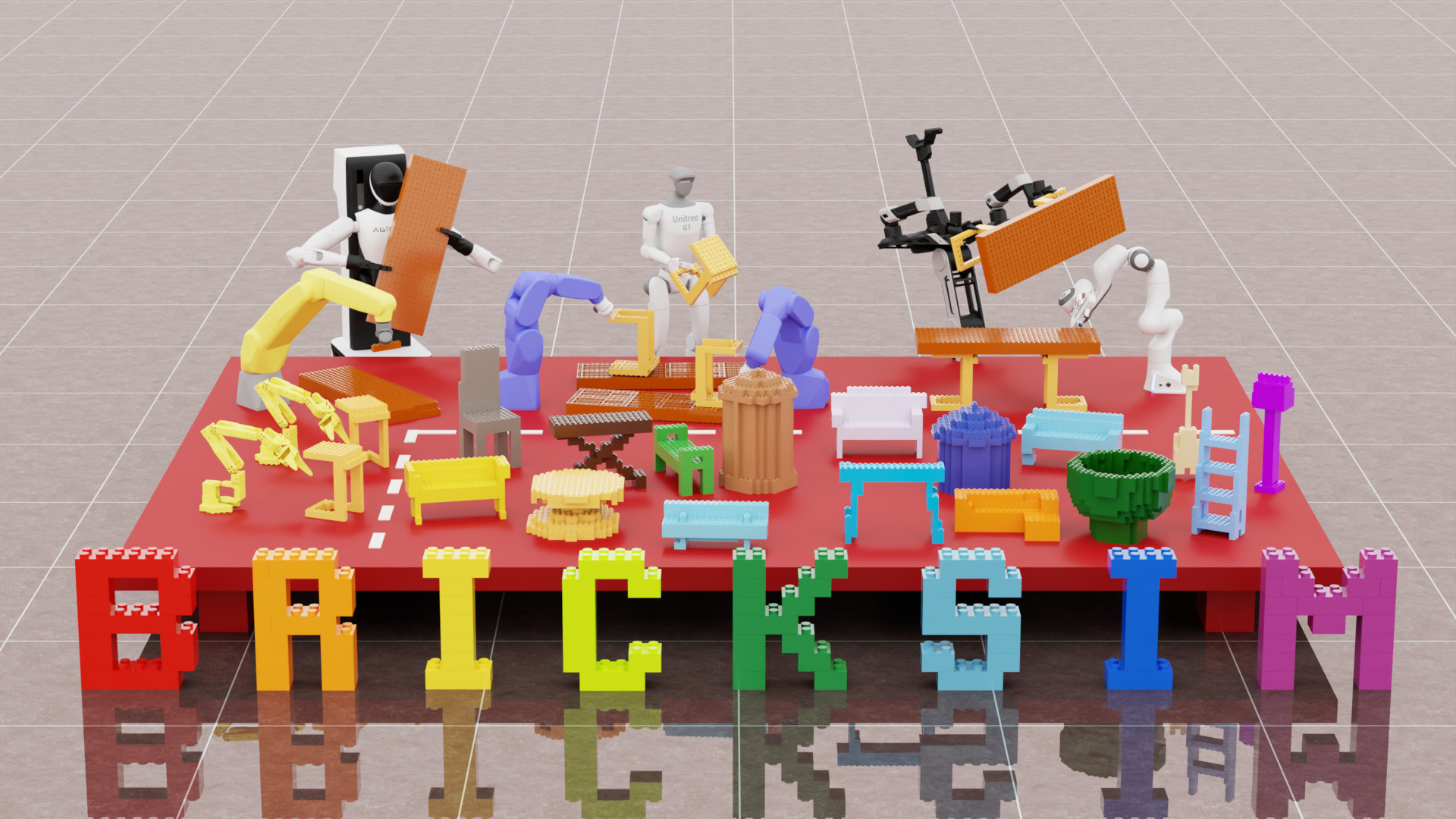
Bimanual robot assemblies by BrickMatic, 10× speed

Overview

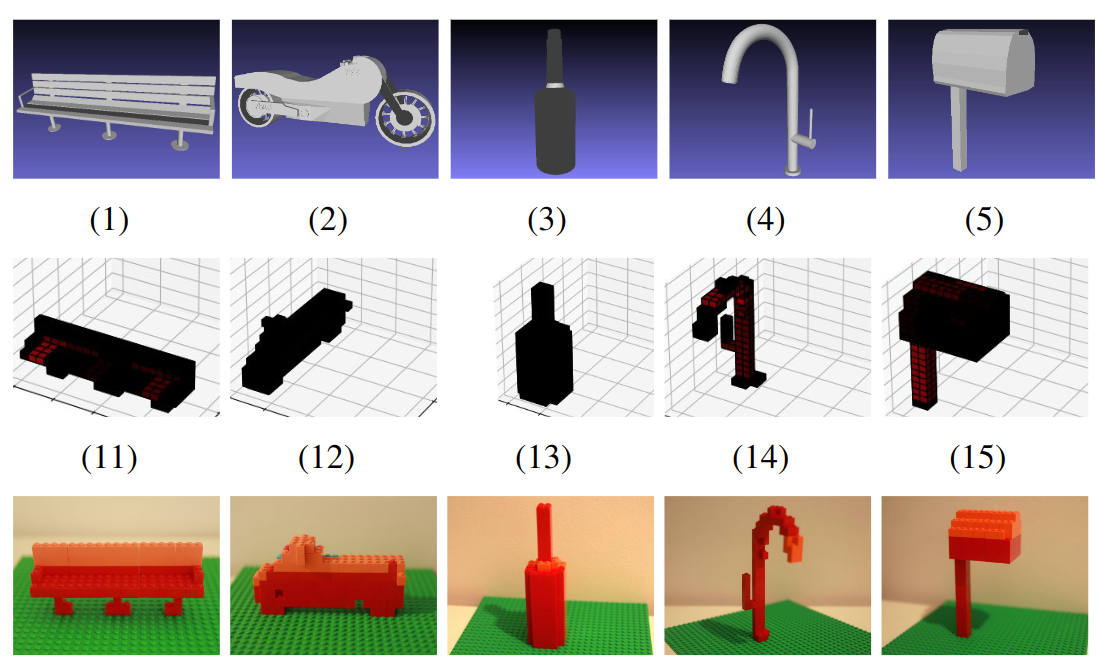
From a single natural-language prompt, Prompt-to-Product designs a physically buildable LEGO model and constructs the real product with a bimanual robot system — closing the loop from imagination to physical artifact.

Prompt → Brick Design → Assembly Plan → Real Product. The system composes a generative designer (BrickGPT) with a bimanual-assembly reasoner (BrickMatic) to turn user intent into a physically-realized object.

Abstract

Creating assembly products demands significant manual effort and expert knowledge in 1) designing the assembly and 2) constructing the product. This paper introduces Prompt-to- Product, an automated pipeline that generates real-world assembly products from natural language prompts. Specifically, we leverage LEGO bricks as the assembly platform and automate the process of creating brick assembly structures. Given the user design requirements, Prompt-to-Product generates physically buildable brick designs, and then leverages a bimanual robotic system to construct the real assembly products, bringing user imaginations into the real world. We conduct a comprehensive user study, and the results demonstrate that Prompt-to-Product significantly lowers the barrier and reduces manual effort in creating assembly products from imaginative ideas.

Method

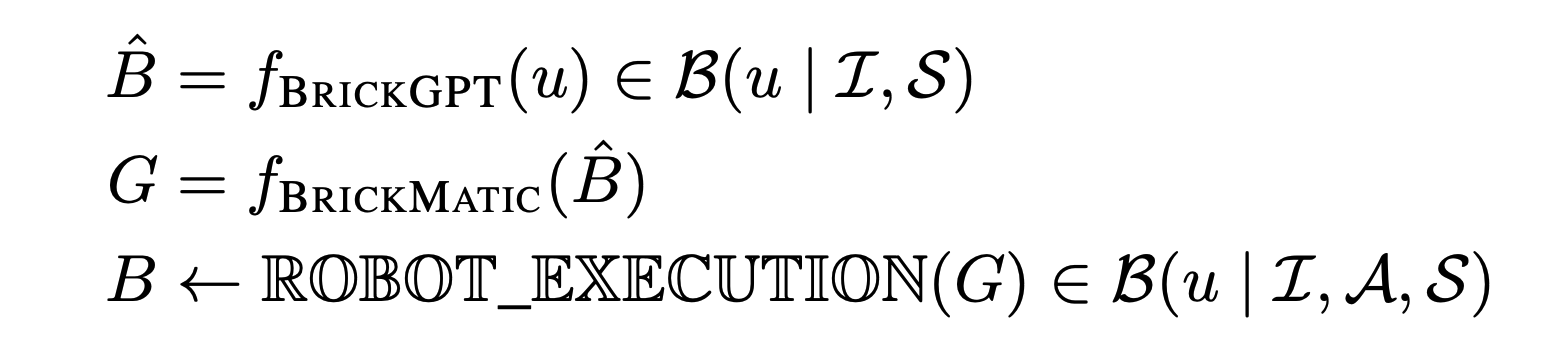
Prompt-to-Product decomposes the end-to-end problem into a generative designer (BrickGPT) and an assembly reasoner (BrickMatic), and hands the resulting plan to a bimanual robot for execution:

Prompt-to-Product equation: B̂ = f_BrickGPT(u); G = f_BrickMatic(B̂); B ← ROBOT_EXECUTION(G)
BrickGPT logo
BrickGPT pipeline with StableText2Brick samples and physics-aware rollback

Fig. 4. BrickGPT couples an autoregressive brick generator with a physics-aware rollback. Given a prompt u, the model emits tokenized bricks size (x, y, z); each step is checked against the brick library I and a physics reasoner S, and infeasible proposals (collisions, out-of-library) trigger resampling until a stable design output is produced.

BrickMatic logo
BrickMatic reasoning: assembly-by-disassembly search and APEX-MR task/motion/action planning

Fig. 6. BrickMatic takes the design , embodiment, and a robot skill set A. (a) Assembly-by-disassembly search recovers a feasible build order; (b) APEX-MR lifts that order into a task-, motion-, and action-level plan G with pick, place, and anomaly-detection skills coordinated across both arms. The plan is then executed by the bimanual system.

User Study Results

Interactive 3D brick designs generated by BrickGPT from user-study prompts. Drag to rotate each model.

Scroll horizontally →

“A classical guitar”
“A sharply contoured guitar with a V-shaped body”
“A basic sofa”
“A soft sofa made of leather that can comfortably seat two people”
“A fancy dining table”
“Table with a long flat rectangle surface”
“Bench with backrest and armrest”
“A racing car with four large tyres and a rear wing.”
“A small sail boat”

BrickMatic Results

BrickMatic plans and constructs the long-horizon brick assembly with closed-loop execution and error detection. Below we highlight how our system detects failure and recovers.

Closed-loop failure detection and recovery. BrickMatic monitors each pick/place action; on detecting an anomaly (mis-grasp or displaced brick) it automatically pauses, alerts the human supervisor, and continues the assembly once the failure has been addressed.

More Assemblies from User Prompts

Scroll horizontally →

“A guitar with elongated neck.”
Full Prompt-to-Product
“A streamlined vessel with a long, narrow hull…”
Full Prompt-to-Product
“An asymmetrical six-string guitar…”
Full Prompt-to-Product
“A soft sofa made of leather…”
Full Prompt-to-Product
Pre-designed Fish
BrickMatic-only
Pre-designed Faucet
BrickMatic-only
Pre-designed Bridge
BrickMatic-only
Pre-designed Chair
BrickMatic-only
Pre-designed Chair (Large)
BrickMatic-only
Pre-designed Human
BrickMatic-only

Citation

If you find our work useful, please cite:

@article{liu2025prompt2product,
  title         = {Prompt-to-Product: Generative Assembly via Bimanual Manipulation},
  author        = {Liu, Ruixuan and Huang, Philip and Pun, Ava and Deng, Kangle
                   and Aggarwal, Shobhit and Tang, Zhenran and Liu, Michelle
                   and Ramanan, Deva and Zhu, Jun-Yan and Li, Jiaoyang and Liu, Changliu},
  year          = {2025},
  eprint        = {2508.21063},
  archivePrefix = {arXiv},
  primaryClass  = {cs.RO},
  note          = {Accepted to IEEE Robotics \& Automation Magazine,
                   Special Issue on Arts and Robotics}
}

Acknowledgement

The authors would like to thank Ken Goldberg, Oliver Kroemer, and Jean Oh for their discussions. This work is in part supported by the Manufacturing Futures Institute, Carnegie Mellon University, through a grant from the Richard King Mellon Foundation.